
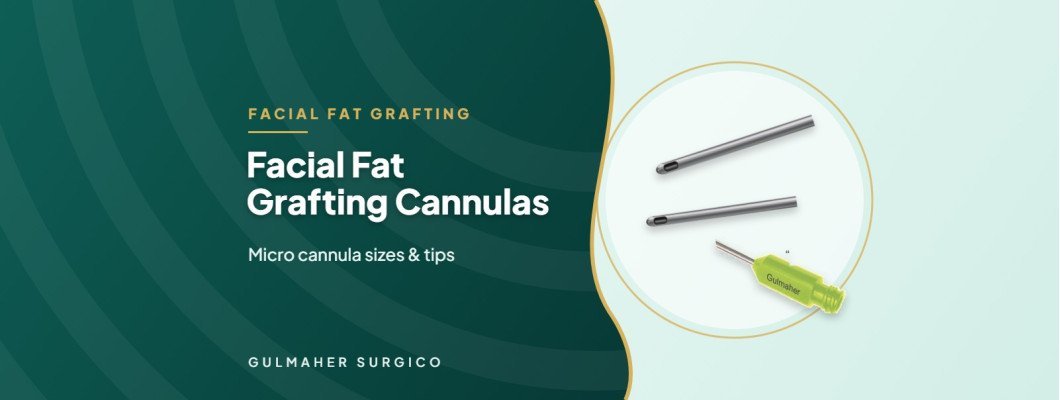
Facial fat grafting relies on small, precise cannulas: fine harvesters to collect small fat parcels and blunt micro cannulas to place them in thin layers. This guide covers the sizes and tip types used for the face. You can also match sizes to products with our cannula selector tool.
Harvesting Fat for the Face
Fat for facial grafting is harvested from the abdomen, flanks or inner thighs with 2–3 mm multi-port harvesters that produce small parcels suitable for fine injection. The Fournier pattern three-port harvester (available from 1.5 mm), Carraway harvester and spiral three-port harvester are common choices. Fine infiltration cannulas such as the micro infiltration cannula prepare the donor site.
Injection Micro Cannulas
Facial injection uses blunt micro cannulas of about 0.9–2 mm, 5–10 cm long, attached to 1 ml syringes with Luer lock hubs. Blunt tips move through tissue with less trauma than needles. Typical choices by area:
- Tear trough and under-eye: the finest cannulas, around 1 mm, placed deep and in very small amounts. See the compact blunt-tip injector.
- Lips and nasolabial folds: 1–1.5 mm blunt injectors such as the round blunt-tip injector cannula.
- Cheeks, temples and jawline: 1.5–2 mm, where slightly larger volumes are placed. The spoon-tip micro injection cannula helps direct placement.
Facial Cannula Size Summary
| Step | Diameter | Length |
|---|---|---|
| Donor infiltration | 1.5–2.5 mm | 10–20 cm |
| Harvesting | 2–3 mm | 15–20 cm |
| Injection | 0.9–2 mm | 5–10 cm |
For gauge equivalents and more sizes, see our liposuction cannula size chart. For body procedures, read our guides to BBL cannulas and breast fat grafting cannulas.
Order Facial Fat Grafting Cannulas
We manufacture micro cannulas, harvesters and adapters in surgical stainless steel at our ISO 13485 and CE certified facility, and supply clinics and distributors in the USA and worldwide. Browse all liposuction cannulas or contact us for custom sizes and private-label orders.
This article is a purchasing reference for medical professionals, not clinical advice.
Planning facial aesthetic or reconstructive work? Browse our complete range of plastic surgery instruments for retractors, forceps, scissors and sets.
Leave a Comment